
Sexually transmitted diseases and sexually transmitted infections are something that I had only ever heard about in sex education classes. Teenagers would use these diseases as insults; the thought of an STD put a disgusting label on you. Well, they were uneducated.
I’m not going to sit here and pretend that either of these things are pleasant; they’re not. But they’re not as bad as the connotations surrounding them. There is a stigma that having an STD or STI makes you a ‘slag’, a ‘slut’, ‘ you’re disgusting’, ‘dirty’, ‘scruffy’, the list goes on.
It can be very scary to get a sexually transmitted disease or infection, but they can usually be treated at any sexual health clinic. Most STIs are just treated with a course of antibiotics, like anything else. You should always practice safe sex with a condom, and this counts for oral sex too. We all make silly mistakes; you can always get free STI tests at any sexual health clinic. I personally would do an STD test after every sexual encounter I had with a new person; it made me feel safer.
Find your closest sexual health clinic: Find sexually transmitted infection (STI) testing and treatment – NHS
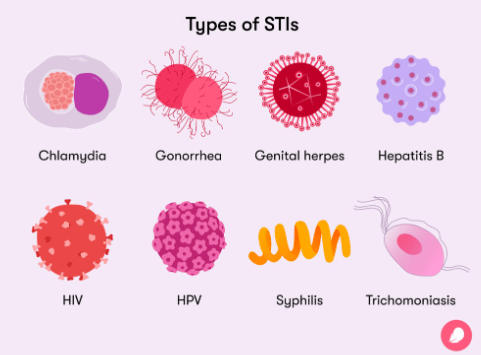
An STI (sexually transmitted infection) occurs when bacteria, viruses, or parasites enter the body, while an STD (sexually transmitted disease) develops when that infection causes symptoms or health complications. STDs can often be developed from an untreated STI, but they’re essentially the same thing.
- Chlamydia
- Gonorrhoea
- HPV
- HIV
- Genital herpes
- HSV 2
- Trichomoniasis
- AIDS
- Syphilis
- An unusual discharge from your genitals or anus
- Could be a different consistency to normal
- Could be red, green, clear, white, or yellow
- Pain when peeing
- Lumps or skin growths around your genitals or bottom
- A rash
- Unusual vagina bleeding
- Itchy genitals or anus
- Pain in the pelvis or stomach area
- Feeling of pressure in the stomach area
- Pain during sex
- Strong vaginal odour
- Blisters, sores or warts around your genitals or anus
- Bumps or a group of bumps in the genital area
- Warts in your mouth or throat, but this is very rare
I feel like STIs have two sides to them. There’s the issue of actually dealing with the problem internally. Then there’s the mental load. Most of the time the mental load weighs heavier than the issue of the STI.
I had an eye-opening conversation with a lady, who I think is better at explaining the mental load than I am.
“I’ve had a few run ins with STIs, and it is one of the most isolating and upsetting experiences I have been through. The first time I got an STD the boy told me he had tested and was clean. I tested after and found out he’d given me chlamydia, I then asked him for his test results and he said his texts delete after a week so he didn’t have them, which if you’ve ever tested you will know is not true. He then continued to brag about it at work, my friend worked with him, so she told me. I felt betrayed and dirty, and ended up in A&E as the infection went to my pelvis. On a separate occasion I had a boyfriend who, looking back I can say with almost 100% certainty, was cheating, probably regularly. When I left him, it was messy and he tried desperately to stop me, I received a message from him a few days later blaming me as he’d come out in a genital rash. I went to the clinic straight away even though I had no symptoms, they said I was probably fine. A few months later I got the same rash and tested positive for HSV 2. I thought my life was over, it was a really difficult time. I had several outbreaks which were very painful both physically and mentally before being put on suppressants. I have realised that herpes isn’t the end of the world and that it really is very common and not easy to pass on but it is something that has been continuously held over me in arguments with partners since. I think we really need to be putting focus on destigmatising testing and placing more emphasis on education into STDs. It’s very possible to still have safe sex even without a condom but there is so much misunderstanding because we simply aren’t taught about it properly. You never think it will happen to you until it does, and sadly people will weaponize that.”
According to the World Health Organisation, in September 2025, more than 1 million curable sexually transmitted infections (STIs) are acquired every day worldwide in people 15–49 years old, the majority of which show no symptoms. As common as they are, they feel like the most isolating thing in the world. This is all due to a lack of education. Sometimes bad things just happen.
An STI is not make or break; it doesn’t make you dirty. It doesn’t define you and never should; it’s just something we all need to understand better without the shame.
And if you’re ever unsure, contact your local GP or sexual health clinic.
 Girlhood 2 Grown
Leave a comment